Showing posts with label Oil Stocks. Show all posts

Sunday, June 5, 2016

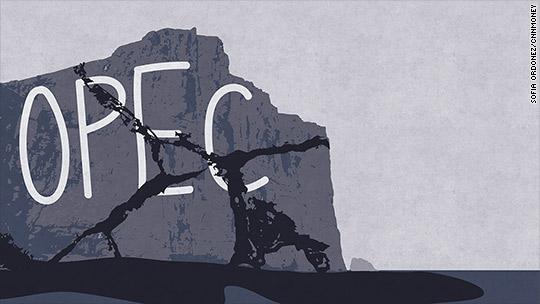
RIP OPEC 1960 - 2016


Summary

  • It's every country for itself now with OPEC.
  • The catalyst that brought an end to OPEC as we know it.
  • Original reason for the formation of OPEC no longer relevant.
  • Why this is good for oil.
Source: CNN

For some time Saudi Arabia clearly stated it wasn't interested in attempting to influence the price of oil after the emergence of the U.S. shale industry. That resolve was tested when Venezuela attempted to leverage its relationship with Russia to press for a production freeze which would have helped push up the price of oil some. Passing the test, it revealed the fact Saudi Arabia was not only committed to the market rebalancing itself, but the reason for OPEC in the first place, was no longer relevant.

Back in 1960 when OPEC was founded, the impetus was primarily to form a cartel which could compete against large corporations, using its supply capacity to influence the price range of oil.

Now that the state-owned Saudi Aramco is preparing for an IPO of approximately 5 percent of the company, it is moving toward being one of those corporations it has been competing against for decades.

The implications for OPEC are staggering, in the sense it no longer has a real reason to exist, and with the Saudis taken steps in this direction, it's obvious it's looking out primarily for its own well being, however it may have an effect on OPEC members. Its ignoring of pleas from Venezuela confirms that's what we'll see going forward, as it struggles for its own survival in the midst of increased competition from U.S. shale producers, which has resulted in the price of oil plummeting and the revenue generated for Saudi Arabia shrinking.

OPEC grew in numbers and influence as more production was nationalized and companies owned by the states were created to produce oil and gas. The cartel was able to keep the price of oil in a desired range by setting quotas for each member, which helped keep the industry profitable. With the emergence of the powerhouse U.S. shale industry, that policy and strategy was no longer relevant or effective as a tool.

Even if Saudi Arabia wanted to keep the old methods in place, shale supply no longer allows it to. It has accepted that, and is taking steps to compete in an oil industry that has been totally disrupted from a player that will become the market leader within a few years.


Catalyst that brought down OPEC


Let me be clear on one thing: it doesn't matter whether or not OPEC as a legal entity remains in place - it no longer has a reason for existence. It is dead, and 2016 will be referred back to by historians as the end of the cartel's purpose for being.

What brought it down was the explosion of the U.S. shale industry, which quickly brought the U.S. oil industry into a top three market leader. It generated almost as much oil supply as Russia and Saudi Arabia, and will exceed them in the near future.

This matters because before U.S. shale, when OPEC decided to curtail or add to production, there were no competitors outside of Russia that was able to interfere with its decisions. Russia could have tried, but it has been producing at near to top capacity, and had little in the way of options to counter OPEC's will, even if it wanted to. The steadiness of the market and consistent profitability made it undesirable to buck the system in place.

That has all changed with shale, where the power to bring oil to a desired price range no longer exists. If OPEC were to cut back on production to drive up the price of oil, shale producers would simply boost production, which fairly quickly would bring oil prices back down. If it were to keep supply high, as it's been doing, it drives down the price of oil, reducing the revenue it was accustomed to have for its people.

Saudi Arabia and OPEC can no longer control the mid- and upper price points for oil, it can only have an impact on the low side of the price because of the increase in supply beyond demand. For that reason the Saudis have called for the market to rebalance, essentially because it has no choice. A number of high-cost OPEC producers didn't understand what the Saudis understood, which is why for a time they persistently called for a production freeze, with the ultimate goal of it leading to a production cut.

The Saudis resisted this because they knew all that would happen is OPEC would lose market share to its American competitors. This is where we are today.

This will only change when demand increases to supply levels, which with current production levels, will take time, contrary to the overly exuberant financial media, analysts and pundits, who are acting like we're on the verge of a rebalancing because of some temporary outages.


Reason for OPEC no longer exists


A lot of investors don't understand the importance of Saudi Aramco engaging in an IPO, even if it's only about a 5 percent stake being offered. To be a publicly traded company includes legal requirements it can't ignore, and that means it will operate much differently than it has in the past. It's a nod toward breaking away from OPEC - at least in its independence from the interests of OPEC members. Whether or not it remains a part of it as a legal entity no longer matters. Saudi Arabia, by its assertions and actions, has already broken away from its reliance and connection to OPEC in any meaningful way.

I say this because Saudi Aramco is moving toward becoming that which germinated the idea of OPEC in the first place - a powerful energy companies.

The new oil market means OPEC members must start thinking in terms of competing on an individual level and not as an entity. This is why Venezuela, in spite of its openly public pleas, is being allowed to descend into the chaos it now faces. That wouldn't have been allowed to happen even in the fairly recent past.

OPEC members weren't going to sacrifice the stability and loss of market share in their own countries in order to support countries that continued to run operations at very high costs. They have years to make improvements, and either didn't have the ability, or believed the price of oil would remain high enough to mitigate their high costs. They were wrong.

More than anything else, this is why there is in reality, no more OPEC. Individual members will increasingly make decisions based upon their own best interests. The weaker members will be forced to adapt or make significant improvements and changes to make their oil more competitive. Over time that would be good for oil.


Why this is good for oil


As a whole, this may seem a disaster for those that had depended upon OPEC in the past to use its influence to produce as stable and fairly stable oil market. But over time, this will bring about a stronger industry that will be driven more by demand and competition, rather than restraints on supply to control the price of oil.

I think we're going to see an oil market that becomes less nationalistic and more free. Those high-cost producers will be forced to make deals with companies that have taken a lot of costs out of production. There will also be an openness to offering larger stakes in national companies, as in the case of Russia, which has already increased the percentage of foreign ownership allowed in its publicly traded energy companies.

For that reason there will continue to be a lot of volatility and lack of visibility in the market, as it isn't something it has experienced for a long time; it could be said even as far back as the founding of OPEC, or even earlier.

When a market emerges that is increasingly driven by the self interests of competitors, it's actually much stronger than when it is attempted to be driven by a cartel like OPEC. It takes a disruption like that by U.S. shale producers to become evident.


Conclusion


With increased competition, companies will be forced to continue to reduce costs while increasing the productivity of wells. This will eventually lead to a lot more profitability for those companies finding ways to increase efficiencies. They will be the future winners, which is why Saudi Arabia is distancing itself from OPEC. It understands it can no longer prop up weak producers who have made little or no improvements for many years. The increase in shale production has brought all of this to the fore.

Saudi Arabia is showing the way for other OPEC members, with Iran playing a significant role as well. Its decision to produce as much oil as is best for the country - no matter what the motivation is - is another show of independence that will eventually spread through all of OPEC.

I don't know if OPEC will continue as a figurehead organization, which is really all it is now. But whether it does or not, its purpose for forming in 1960 is no longer there, and energy investors need to look at each country as a standalone producer. That is how it'll play out long into the future.


Source: Seeking Alpha

Sunday, August 9, 2015

The Top 6 Reasons Oil Prices are Heading Lower


One of the major reasons as to why the RM is falling is the drop in crude oil prices as Malaysia is known to be an oil exporting nation. So will the oil prices recover? I think not so be prepared for more pain ahead .. Oil prices drop --> RM drop ---> stock market drop  ..get it ?


Here are the top 6 reasons that oil prices will remain weak for a long time. 

I re-posted the excerpts from oil-price.net for your own reading and analysis -


1. Iran Returns


Despite heavy fines by the US authorities against anyone trading in any way with Iran, that country has still managed to continue oil production over the past few years. Sanctions against Iran have existed in various forms since the eighties when religious fundamentalists overthrew the West-friendly Shah of Iran and committed a series of terrorist attacks against Western nationals. However, sanctions ramped up to the point of shutting Iran out of the oil markets in January 2012, when the US insisted that Iran cancel its program of tests of nuclear weapons.

At the beginning of April 2015 Iran signed an agreement to end its nuclear program and let in international inspectors to prove its commitment. Confirmation of Iran's compliance will remove the biting sanctions of 2012 and bring Iranian oil to international markets. Despite being stymied by US and EU sanctions, Iran is still able to produce 2.7 million barrels per day, of which 1 million is exported. The un-exported 1.7 million barrels meet domestic demand, but a large proportion is sent to storage.

The world currently has excess crude oil production of roughly 2 million barrels per day, so a cash-strapped, and slightly embittered Iran could have immediate impact on crude oil prices by putting its estimate 35 million barrels of stored oil on the market the day sanctions are lifted.

The impact of Iran's return to the market greatly depends on how quickly they can ramp up production. Bijan Namdar Zangeneh, Iran's oil minister, claims that the country could easily increase production by 1 million bpd within months of the lifting of sanctions. That worrying figure would increase the world's excess production by 50 per cent, which some analysts claim would push crude oil prices down to $20 per barrel. However, other analysts are skeptical.

Iran's production levels were at 4 million barrels per day in 2011 before the latest round of sanctions hit. Iran's isolation and denial of technology and investment capital means its oil industry has become badly under-invested. Their ability to get back up to former production levels could also be blocked by OPEC, of which Iran is a member. Nevertheless, Iran's return will prevent the world's excess supply from being reduced and so prices will fall.


2. Fracking is Not Going Away


Many believe that the 2014 fall in oil prices was specifically engineered by Saudi Arabia to knock out US oil production through fracking. Industry analysts estimated that heavy start up costs and financing requirements placed the break-even point of a fracking rig at around a $70 per barrel price of crude oil. Many saw the slump in the price of crude down to $60 and then to the $50 mark as a significant factor.

Sure enough, the rig count in the USA plummeted from 1,608 in October 2014 to 747 in April 2015. Seemingly, the lower oil price had squeezed out US oil production in the higher-cost fracking sector. However, the advancement of technology and the agility of fracking producers resulted in higher output from fewer rigs. In October 2014, the USA produced just under 9 million barrels per day. In April 2015, that output had increased to just under 9.5 million barrels per day.

Chinese oil production through fracking has risen to the same extent as USA production, with companies in both countries adopting and improving the same technology. In a world with an excess production of 2 million barrels per day, America's increased production means that oil prices are not about to rise. China's increases compound that situation.


3. OPEC is Idle


Previous oil price falls have been keenly countered by OPEC, the cartel of oil producing nations, centered mainly on Middle Eastern producers. Whenever oil prices fall, OPEC cuts quotas to its members, limiting their production and causing the price to rise through reduced output.

Saudi Arabia is by far the biggest producer in the OPEC club and the opinion of its oil minister, pretty much rules the actions of OPEC. If OPEC members decide to cut their production, but Saudi Arabia refuses to play ball, the resolution to cut would have no impact on oil prices, and thus be a worthless exercise.

Fracking started to provide the USA with a means of achieving energy independence. The country has already become a net exporter of gas, and similar performance in oil production would remove the USA's dependence on the Middle East for its oil supplies. Saudi Arabia's dominance of American oil supply enables them to entice the USA to deploy its military in the Persian Gulf at the direction of Saudi foreign policy. The Saudis want to return to the days of US dependence on Arabian oil and so refuse to cut their production in the face of falling prices.

Despite the apparent failure of the Saudi production tactic, OPEC shows no signs of changing its policy. The Saudis seem to be determined to continue forcing the price of crude down to squeeze out US production, but as fracking gets cheaper, output will continue to expand and the price of crude oil will continue to fall.


4. Russia Produces More


Political analyst point out that oil prices fell dramatically around the time that Russia invaded the Ukraine and the EU dithered over imposing the sanctions that the USA demanded. Although Europe did eventually go along with the policy of punishing Russia through trade restrictions, their reluctance to really hit hard has undermined US strategy.

Eyeing the success of an embargo on oil sales in bringing Iran to the negotiating table, the US administration, the theory goes, decided to depress the price of oil in order to bankrupt Russia and force it to cancel plans to take over the Ukraine. The Russian economy is overwhelmingly dependent on oil and gas exports, because it has little successful industry and is unable to match the West in the development of technology.

Saudi Arabia also has a cause to complain about Vladimir Putin's behavior. The Saudis loathe Bashar Assad, the President of Syria and want to see him overthrown. American and European governments seemed willing to play along with this policy until the Russians threw their support behind Assad and European determination folded. Without any significant allies to share the burden, the USA cancelled their planned invasion of Syria. The infuriated Saudis decided to take matters into their own hands and collapsed the price of oil with the intention of punishing Russia, not US frackers.

Vladimir Putin and his administration have complained loudly and frequently that the oil price fall was deliberately aimed at attacking the Russian economy. However, the steadfast determination of unrealistic quotas haunts the Russian mentality as an overhang of the Communist era. Putin needs money to continue his glorious and domestically popular policy of reassembling the Russian Empire. The Russians refuse to bend to market forces and so have made up the shortfall in their budget caused by falling oil prices by pumping out more oil. The Russian need for income means they are unlikely to make a tactical cut in oil output. Increased production adds to the downward pressure on crude oil prices.


5. ISIL's Days are Numbered


The Islamic State of Iraq and the Levant are said to be causing havoc with oil production in the Middle East. ISIL, originally called "the Islamic State of Iraq and Syria," first came to the world's attention when they threatened takeover of northern Iraq and Syria in the autumn of 2014 – just after the USA declared they would not intervene in Syria to overthrow its president.

Oil analysts talk up the oil price by warnings over ISIL's actions. However, the revolutionaries only managed to grab a small portion of Iraq's oil wells and actually increased production of their new assets in order to fund their cause. The ISIL bogeyman delayed the fall in oil prices by about a month and the havoc they have wrought across the Middle East has since failed to block that overproduction of 2 million bpd.

ISIL's greatest success in wrecking an oil producing country came in Libya, where they apply different tactics to the oil industry. Rather than profiting from Libya's oil wells, ISIL has been destroying them, thus knocking out a major oil producing nation. Simultaneous increases in production in the USA, China and Russia, however, mean that the loss of Libyan output has had no impact on the glut of crude oil in the world. The panic pricing in the oil markets that the group's initial appearance caused has withered away.

Europe's willingness to turn a blind eye to ISIL's activities in Libya came to an abrupt end in mid-April. Deciding to knock out oil production, rather than profit from it, ISIL turned to Libya's other money maker – people smuggling. The short distance between the Libyan coastline and the Italian island of Lampedusa makes the former slave trading ports of Libya ideal routes for illegal immigrants to sneak into the EU. Unfortunately, the greed and carelessness of the smugglers has resulted in overloaded ships sinking in the middle of the Mediterranean.

The death toll through drowning of ISIL's passengers has reached headline-grabbing levels and Europe's major military powers have resolved to put an end to the organization's activities. Although the smuggling gangs are the proposed targets of European airstrikes, the difficulty of identifying those activists means that Europe will have to restore a legitimate government to Libya in order to stop human trafficking.

It is significant that the proposed European strategy is to join Egyptian military efforts. The Egyptians have been routinely bombing ISIL in Libya since February. ISIL is easier to attack than other terrorist groups. With a standing army, rather than a terrorist cell structure, such as that of Al Qaeda, ISIL is more visible, and so can be engaged by a traditional military response. Its system of local governors and administrators require offices and infrastructure that are fixed and easy to bomb. The imminent defeat of ISIL in Libya means the oil industry there will be able to rebuild, the world's oil production excess will increase and crude oil prices will fall further.


6. No Demand


The excess supply in the oil market could easily be mopped up by increased demand. However, there is no great leap in growth expected in the world for the next couple of years. Energy efficiency and investment in renewable energy, such as solar, has permanently reduced demand for oil in most of the developed world.

Both the Federal Reserve and the People's Bank of China have announced they are ending their loose monetary policies. This free money pumped around the world inflated the prices of property, stocks, bonds and commodities. Part of the reason the oil price rose through 2013 and early 2014 was simply that the excessive amount of dollars in circulation had to be invested in something. Now that money has to be paid back, the asset price inflation of the past two years will be reversed.

The BRIC economies have failed to continue their stratospheric growth into 2015. In fact, some developing nations, like Brazil, are now in recession, with tumbling currencies cutting their populations' spending power. World trade is falling and demand for oil will fall with it. With few prospects of increased demand for oil, the chance of its price rising is zero.


Conclusion


The major oil producers have done nothing to cut production since October 2014, and they are unlikely to consider cutting output any time soon. The USA, Russia and Saudi Arabia each have different reasons to continue high output, but all three are just stockpiling oil because they cannot find enough immediate buyers. Add on the inevitable return of Iran and Libya and the prospects of the 2 million bpd excess production in the world reducing can be seen to be impossible.

Monetary tightening will reduce world growth and remove asset price inflation. Lower growth, coupled with lower need for oil through efficiency and environmentalism, means demand for oil is not going to exceed supply for a long time to come. The oil price is not going to rise any time soon.

Thursday, April 9, 2015

The Guillotine and The Sandpaper


It's one of the biggest questions in the market right now... And we're worried lots of people are getting the answer wrong.

The question: Is it time to buy oil stocks yet?

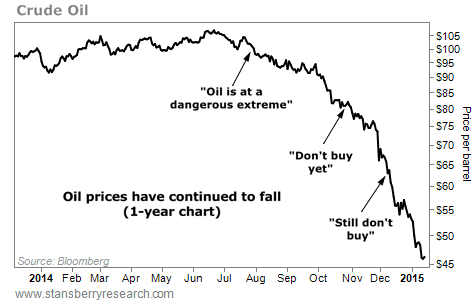
In late July, we warned DailyWealth Traders that crude oil was due for a decline. We pointed out that sentiment (as measured by fund-manager positions) was extremely bullish toward oil, which is a bearish signal.

Since our warning, oil has crashed. It's fallen from $102 per barrel to $45 per barrel. As contrarian traders who hunt for crisis situations, oil has been on our radar...


Some folks are already buying oil stocks. They believe they've hit bottom. For example, top financial weekly Barron's recently ran a cover story that encouraged readers to buy a handful of oil stocks. Many of the talking heads on financial television say they're buying oil stocks.

Other than buying them for a very short-term bounce (like 1-2 weeks), we recommend NOT buying oil stocks right now. There's a great chance some "sandpapering" is on the way.

And it's important that you know what sandpapering is...

In June 2013, we published an essay in DailyWealth Trader on "The Guillotine and the Sandpaper." In the essay, we explained the idea...

It was first described by legendary market analyst Bob Farrell...

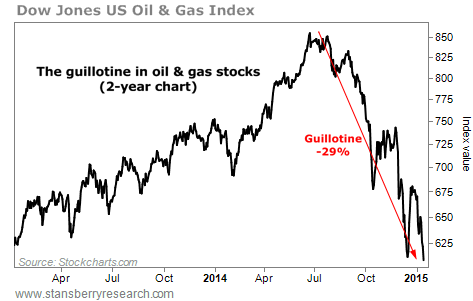
You start with a dramatic drop [in asset prices]. Prices fall 20%, 40%, even 70%. That's the "guillotine." Then comes the "sandpaper": a period where prices move up and down without going much of anywhere. This go-nowhere action exhausts anyone who is still left holding. Eventually, everyone gives up. When there are no sellers left, prices can start to rise.

In other words, the guillotine is what happens when a market suffers a sharp selloff in a short time... and sets up an opportunity to trade a recovery. But before the recovery takes place, the asset often spends months or years moving sideways. That's the frustrating sandpaper phase. It's just how the market works.

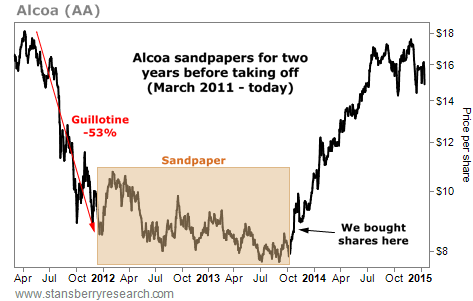
Consider our huge winning trade on aluminum giant Alcoa. In 2011, Alcoa suffered a near-50% drop. Instead of rebounding quickly, it "sandpapered" shareholders for two years. We waited... and jumped in right as the sandpapering ended. We made 80% in less than a year. You can see sandpaper phase in the chart of Alcoa below:


Or... consider airline stocks over the past four years.

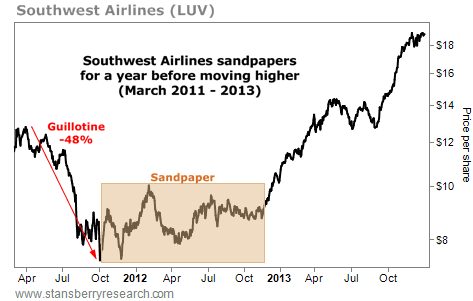
In 2011, airline stocks suffered a huge 45% drop. And while they ended up recovering and running higher, they spent more than 15 months trading sideways. They spent more than 15 months "sandpapering" traders who bought right after the drop. Then in late 2012, airline stocks started moving higher. You can see that sandpaper phase in the chart of leading airline Southwest Airlines.


Again, sandpapering after the guillotine strike is usually how the market works. It takes time to absorb the shock of lower prices and form a bottom.

And since many folks are still bullish on oil stocks today, we believe they'll trade sideways (or even lower) for at least several months. It could take more than a year for the sector to digest its huge recent loss... and frustrate the people who just bought shares.

You can see the guillotine in this two-year chart of the Dow Jones U.S. Oil & Gas stock index...


Now that oil stocks have suffered the guillotine strike, expect a sandpaper phase. The vast new supply of oil from North American fracking should keep prices below $60 for years.

These lower prices will start filtering through oil-company income statements and balance sheets. Companies will report much lower asset values. They'll start reporting shockingly low earnings. Some of the companies that have taken on lots of debt will go bankrupt. We're sure a few companies will be busted for questionable accounting and overstating reserves (it always happens after major tops).

There will be a relentless supply of bad news from this sector... which will keep the investment public away.

Of course, we can't know how long the oil sector will take to frustrate the people who just bought in. But it's likely to be at least six months. We're sure experienced short-term traders (like our friend and colleague Jeff Clark) will be able to trade short-term rallies. But for traders and investors with longer time horizons, it's best to avoid oil stocks right now. They're due for a sandpaper phase.

When oil stocks finally rally, the gains could be enormous. But it's best to stand aside right now. We're monitoring the sector closely... And we'll update you as it plays out.

But for now, we'd much rather focus on sectors that will benefit from consumers paying less for gasoline... Stay tuned for more on this idea.

Regards,

Brian Hunt and Ben Morris